
Updated: 05/04/2026
Searches for “best AI assistants” sound like people are looking for a ranking, but in reality the “best” assistant depends on the task. Some people need a tool for work, others for learning, planning, routines or daily organization. Below, we look at practical selection criteria so you do not have to rely on loud marketing promises.
Why Rankings Are Often Not Very Useful
Most rankings compare tools “on average.” But you need an assistant for a specific scenario: writing emails, creating plans, explaining topics, supporting habits, sending reminders or organizing tasks.
That is why it is better to look not for a universal “top 1” tool, but for a clear set of criteria and the assistant that is convenient enough to use every day.
Criteria That Actually Matter
- Convenience. Can you open it and write a request in a few seconds without complex setup?
- Response format. Can the assistant answer in a structured way: steps, lists, options and summaries?
- Context. Does it remember the conversation, or do you have to explain everything again every time?
- Limits and transparency. Is it clear how usage limits work and why they run out?
- Language quality. Does it avoid robotic wording, awkward phrasing and unnatural tone?
Choosing by Use Case
For Work
A good AI assistant for work should quickly create drafts and help with structure: emails, proposals, meeting summaries, project plans and task breakdowns.
For Learning
For learning, the most important features are simple explanations, practical examples, exercises, self-check questions and the ability to turn large materials into clear study notes.
For Planning
For planning, checklists, task decomposition and habit formation matter most. If the assistant is inconvenient, people simply stop using it.
Free Start and Honest Limits
One good sign of a reasonable service is the ability to try it without pressure. Not “five messages and goodbye,” but enough room to actually test a real use case.
Token-based or volume-based limits are often more transparent than simply counting messages, because one request can be very short while another can be much longer.
Why the Telegram Format Often Wins
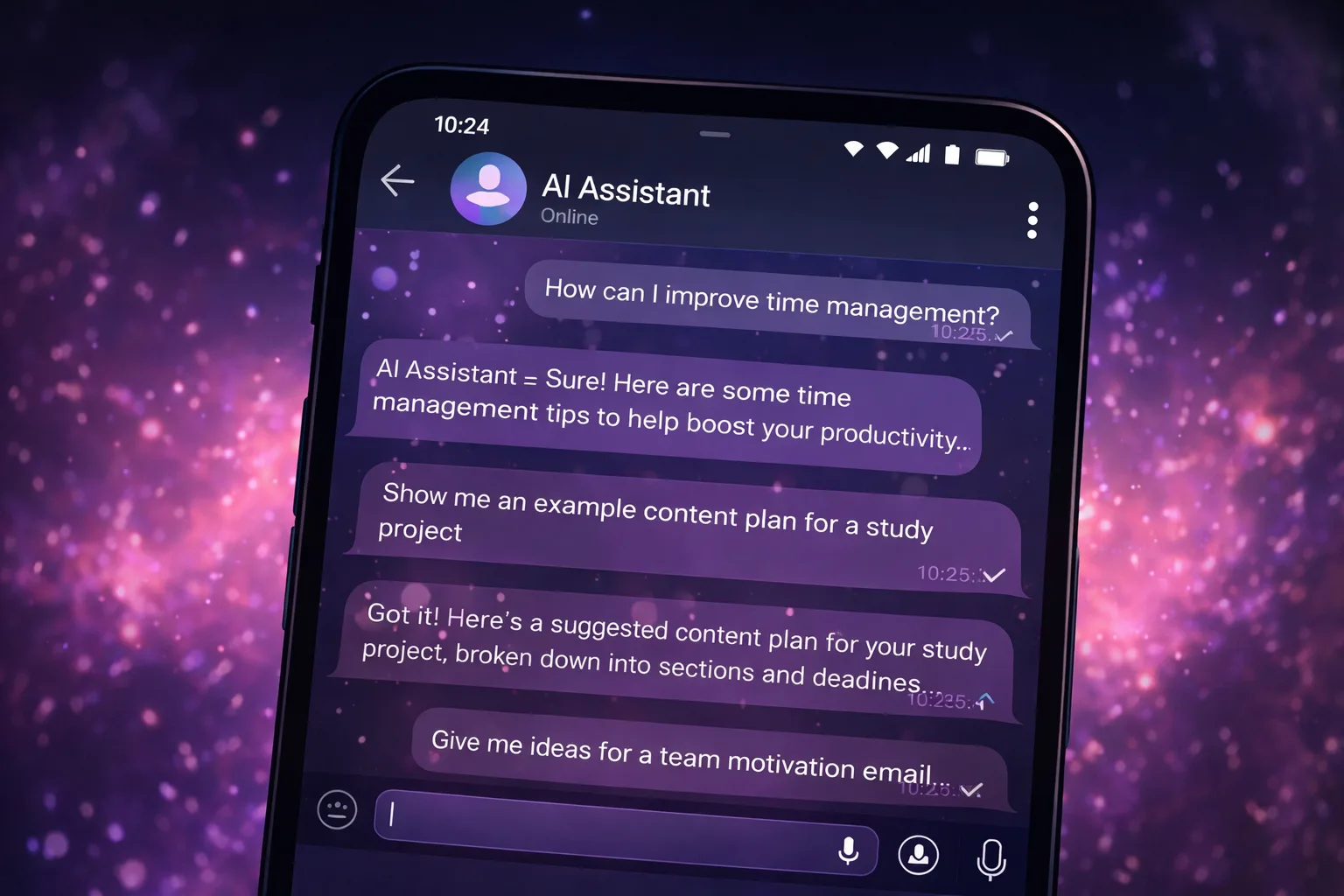
A messenger works well because it is already a familiar environment. The assistant does not become yet another app you need to remember and maintain. It lives where you already communicate.
Our Approach
We are building a Telegram-based assistant focused on practical use: modes, structured response formats and routine features such as reminders and rituals. It is not “magic.” It is an attempt to create a tool people can realistically use every day.
Important: the project and all materials operate in a safe format and do not include adult (18+) content.
FAQ
FAQ
What is an AI assistant?
An AI-powered helper for writing, planning, brainstorming, explanations, checklists and everyday tasks.
Can I start for free?
Yes. You can try the format for free and see whether it fits your workflow.
Does it contain adult content?
No. The project operates in a safe and family-friendly format without adult (18+) content.