
Updated: 04.05.2026
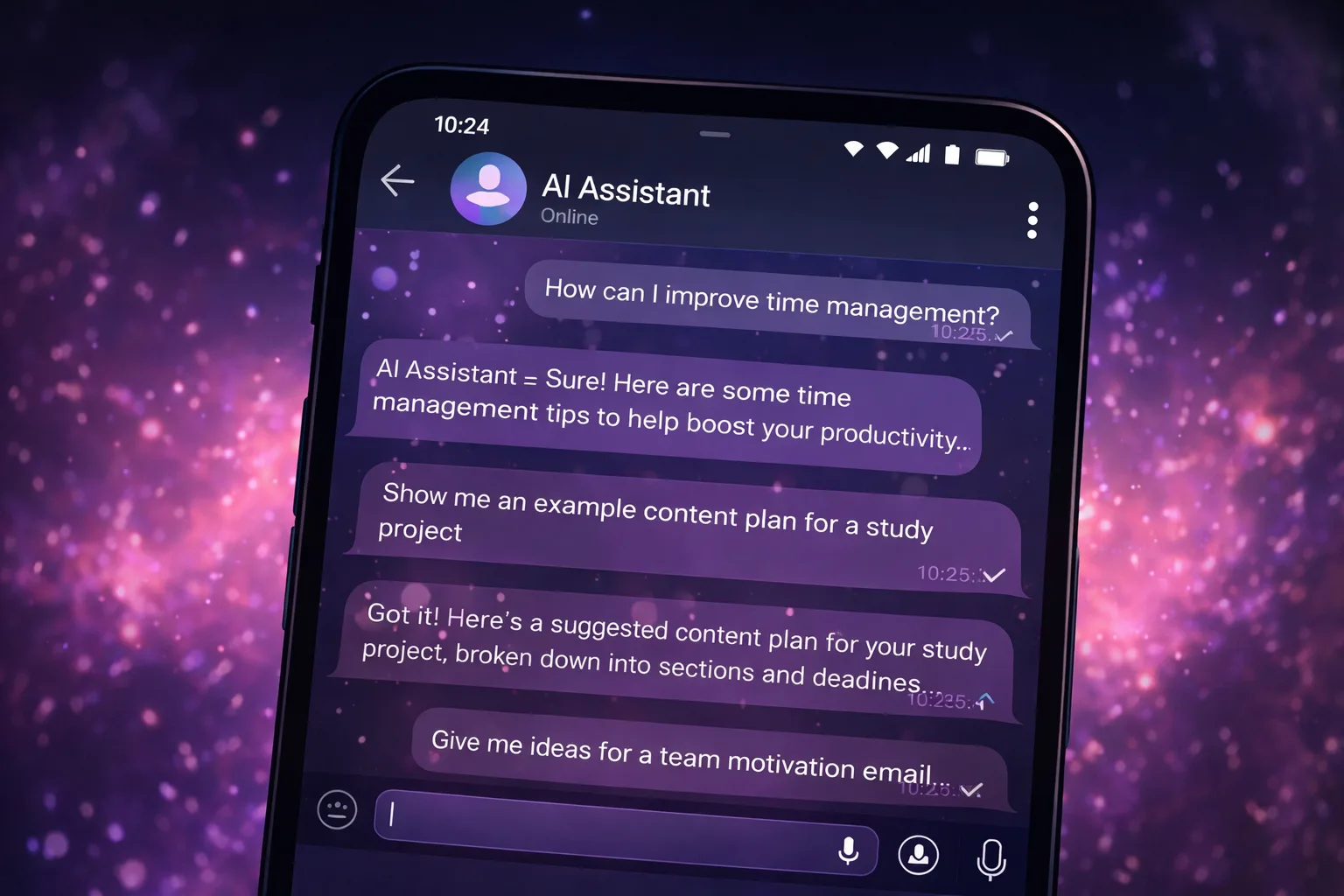
When people search for "AI assistant examples", they usually want to understand what an AI assistant actually looks like in everyday life — not in marketing promises. Below are practical scenarios where an AI assistant can provide real value: work, learning, planning, writing, habits, and daily routines.
Why examples matter more than feature lists
Feature lists often sound the same: "writes content", "helps with planning", "explains things". But people only understand the value when they see a familiar situation and a clear outcome.
That's why this page is not about "smart AI". It's about how an AI assistant solves specific everyday problems.
Examples for work
- Client email. Draft a professional reply that is polite, clear, and includes a logical next step.
- Meeting summary. Extract key decisions, action items, responsibilities, and deadlines.
- Project planning. Outline phases, risks, priorities, milestones, and what should happen first.
Examples for learning
- Topic explanation. Explain a concept in simple language with examples and a small practice exercise.
- Study notes. Summarize material into concise bullet points and highlight the most important ideas.
- Exam preparation. Build a revision plan and generate self-check questions.
Examples for planning
- Daily planning. Identify three priorities, allocate time blocks, add buffers, and remove distractions.
- Weekly planning. Define goals, key tasks, schedules, and progress checkpoints.
- Task breakdown. Turn a large, complicated goal into a sequence of manageable steps.
Examples for writing
- Social media post. Generate multiple versions with different tones and lengths.
- Service description. Structure customer problems, solutions, benefits, and FAQ sections.
- Editing and rewriting. Simplify text, remove fluff, and improve clarity.
Examples for routines and habits
In this area, an assistant is useful not because it is "smart", but because it is consistent. It helps maintain routines and prevents small things from being forgotten.
- Reminders. "Remind me at 7:30 PM to pay the invoice" or "Call the client in two hours."
- Daily rituals. Morning check-ins, hourly water reminders, or an evening reflection about the day's progress.
How to choose the right example and get started
Pick a single scenario that repeats every week. Don't try to automate ten things at once.
Good starting points include: "meeting summaries", "daily planning", or "email drafts".
If an AI assistant helps with one recurring task, it will usually become useful in many others as well.
How this works in llmgirl
We build our AI assistant around practical work and lifestyle scenarios: response modes, quick Telegram interactions, reminders, and daily rituals.
But the main idea is not the product itself. The biggest improvements usually come from small, repeatable workflows that save time every single day.
Important: llmgirl and all related materials operate in a safe environment and do not contain adult (18+) content.
FAQ
FAQ
What is an AI assistant?
An AI-powered helper for writing, planning, brainstorming, explanations, checklists and everyday tasks.
Can I start for free?
Yes. You can try the format for free and see whether it fits your workflow.
Does it contain adult content?
No. The project operates in a safe and family-friendly format without adult (18+) content.